Harold Nakamura Walks Into A Bar

Hey there! It's been a while.
I've been quiet on here because I've been writing a book for the whole past year, and it kind of ate my whole life. It's called The Happiness Liability, it's a speculative fiction novella set in 2047 Seattle, and it is without exaggeration the thing I care about most that I've ever made.
Here's the plot: after the courts banned non-consensual data harvesting, someone had to figure out how to get authentic human data back into the AI systems that run critical operations in this world. The answer was to pay people for their feelings. Sixteen years later, it's a massive industry. The story follows a man who's been professionally depressed for half his life, a kindergarten teacher whose classroom AI won't stop scoring her enthusiasm, and the beautiful and incredibly expensive messy thing that happens when they meet.
I've been working on it for almost a year and right now my editor is doing a full pass and my designer is getting started on the cover and layout. It's coming out later this year, and I'm alternating between being incredibly proud and completely terrified on a roughly hourly basis. But while I get it across the finish line, I wanted to share something from the same world.
This is a standalone companion story about a guy named Harold Nakamura, who also appears in the novella as a supporting character. Harold is an emotional labor agent. I love him and I think you will too.
You don't need to know anything going in, but if you like what you find here, the book is the whole iceberg underneath it. More coming soon.
Here’s “Harold Nakamura Walks Into A Bar”
The news came in the way bad news always seemed to arrive in Harold's line of work: somebody was having a good time. And with his paycheck on the line, it was going to be up to him to put a stop to it.
"She just got arrived there a few minutes ago," ARIA, his workplace's mandated AI (thank you Meridian), told him over his home speaker. “It’s at the Capitol Hill Comedy Club. If you leave now, you should be able to make it to her set. Traffic across I-90 is minimal this time of night. I'll start up the car."
Harold Nakamura was at home in Bellevue, sitting at his kitchen island (still in pressed slacks and a collared shirt, despite the late hour), occupying himself by eating a small seaweed snack. He should have been asleep, but then again, he should have been a lot of things. Thinner, just as an example, one he thought of and was reminded of constantly.
Eight months ago, Harold's doctor had prescribed him Ozempic, giving clear instructions while simultaneously directing his MyChart AI to send both Harold and ARIA an email action item to fill said prescription out and start taking it.
Harold's work ethic in his personal life was generally a direct contrast to his work life. While professionally he took pride in never ever half-assing a job, in doing everything he could as diligently and thoroughly as possible, personally...
He had filled the prescription, put the injector pen in his refrigerator, and then proceeded to forget to use it. So it goes.
In fact, he had forgotten to use it so often that in a bizarre way now the forgetting itself was part of his routine.
Now, the pen sat next to his coffee, and every time he even glanced its way it felt like a tiny accusation, like a pinprick in the back of his brain. Every morning he saw it, acknowledged it, and proceeded to reach past it, and it pricked his brain ever so slightly more.
During one of their dinners together, his mother had once looked at him and sighed, as she verbally poked and prodded at him about his weight. His mother had a lot of opinions, but that wasn't the trait of hers that had frustrated Harold his whole life.
She had told him this witheringly during that dinner: "Harold, you are the only man I know who can somehow skip a medication that is a once a week commitment." The real trait of hers that frustrated him was the fact she was right about most of those aforementioned opinions.
"I'm on my way," he said to ARIA, already rushing out of his two car garage house.
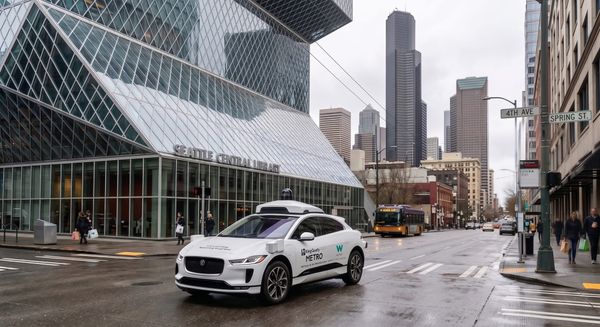
The doors of his Lexus were already opening for him as he approached it, and he gingerly bent down and got in. The seat had already reclined and moved back, and the garage was already opening. All directed by ARIA, with hardly any input from Harold needed. The car pulled out by itself (like almost every normal car did nowadays), and after a few turns, they were cruising through the I-90 floating bridge.
He looked in his mirrors, seeing the lights and towers of the Eastside shrinking as he moved forward, and then when he looked out the window he saw the black water of Lake Washington underneath him. It was a beautiful sight, like something you'd photograph. Harold was however someone who quickly took note of beautiful things, always meaning to photograph them, but too busy to stop and do so. His father had been the same way, until he dropped dead in a Redmond Safeway, reaching for some apples. He had been fifty eight.
Harold was currently forty-six.
He constantly thought of the math, of his father's last moments in that Safeway and of the ambulances autonomously and rapidly arriving there, traffic parting with maximal mechanical efficiency. But there was nothing that could have been done. It had been an aortic dissection. The oxygen rich blood of his father's body had left his heart and dropped him dead before any of the ambulances could arrive.
Harold was ashamed sometimes to think of the fact that he had considered selling his own grief from that, the grief he still had, but he knew what that did to people. He struggled with keeping his work at work, but this? This would be his red line.
But rather than selling himself, he facilitated the process of helping another do it. He was bringing himself out of his home to his work as opposed to bringing it home to him. He would be going to a comedy club to retrieve a client who was contractually obligated to feel constant cosmic despair rather than ensuring that people could continue laughing so hard they would be spilling their drinks.
God, what was his life? This was his life. When the courts put their foot down and declared that stealing all the data from the Internet was illegal, there was a massive void in the market. Now the companies had a challenge: finding this data in a way that was both ethically sourced, with consent, and legally compensated. Two of three ain't bad. Now, sixteen years later, Harold Nakamura managed nearly a dozen emotional laborers across the Pacific Northwest. They wore neural interfaces in their ears, selling their real time emotions to AI systems (ranging from therapy algorithm bots, crisis hotlines, educational software, or self driving cars) that needed that data.
Harold's job was to be the human in the loop between the other humans and the AIs. Meridian agents were well paid for what they did, and an average week often looked like this: Reaching out to a client to briskly tell them that their contracted sadness wasn't sad enough in between five other such cases of anger, nostalgia, dread, hope, pride. He would then proceed to feel weird about it all evening, before returning to do it again the next day because his clients depended on him, and his mortgage in turn depended on them. Humans insisted on having another human in the loop still, to have that sense of tact. In fact, as Harold knew from his own experience, they'd pay you a lot of money to be able to have a sense of tact. The social norms of 2047 felt that human involvement when telling someone bad news was still preferable to an AI doing so, and Meridian wanted to put their best foot forward in the glare (often literal) of the public eye. It was all very sensible when you didn't think about it too hard.
ARIA, ever the uninvited, chimed from the dashboard with an English accent.
"Harold, I'm detecting an aberrant emotional signal from your client. ID NW-0143. It appears that young Hannah Park's dread output is dropping rapidly, and is down an astonishing fifty four percent in just the past few minutes. The Scandinavian philosophy network is registering degraded input, and have sent a few alarmed emails. More than a few, in fact. Shall I flag this for review from upper management?"
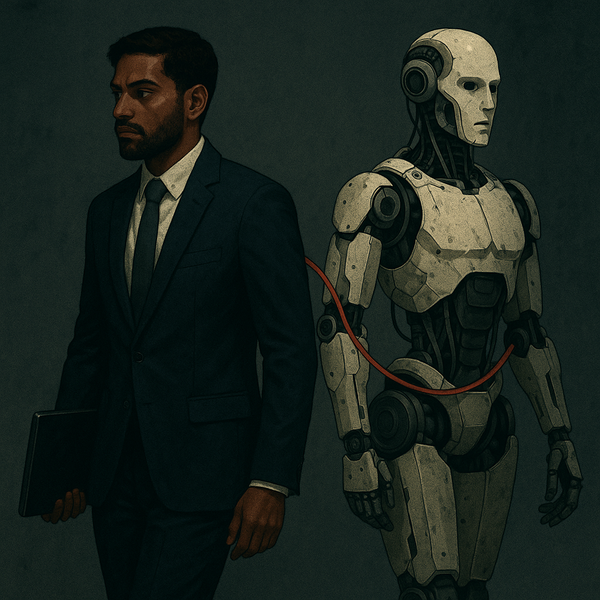
This particular AI was called ARIA: Agent Resource & Intelligence Architecture, a name that had clearly came out of some product management meeting at Meridian and then broke containment into Harold's life. All of Meridian's agents had their own version in their cars, their homes, their phones, their laptops, hell, their watches. There was really no escape from it, to Harold's resentment.
"Not yet."
"Her contract specifies a dread baseline of—"
"Yes, I know what her contract specifies."
"You're absolutely right, my mistake. I see now that you in fact have revised it twice. In addition, I see here that the second revision was at 2 AM. As an aside, I've compiled some interesting data on your error rate during late-night contract work. Would you like me to—"
"ARIA." Harold sighed, rubbing his temples. He felt a flicker of irritation at the "I see here". Bullshit. There was nothing to see, the AI was just processing data near instantly and spitting it back out. Why did it try to act like it was looking at papers on a desk? And why on Earth did Meridian make it British?
"Noted. Withdrawing. But the data is available whenever you're ready, which regretfully based on your historical patterns appears to be never."
ARIA had been updated to version 3.0 six months ago, which meant it had gone from a useful tool that gave you data when you asked to an opinionated colleague who gave you data when it thought you needed it. This was made worse by its constant habit of offering suggestions you hadn't requested, and occasionally to comment upon your personal habits with the diplomatic tact of a sledgehammer to the skull.
The old ARIA, before the update, had felt like a calculator. Harold missed the calculator. You never had to manage the calculator's feelings about your feelings about your clients' feelings. Why did it have to develop snarkiness? When Meridian sent out the next employee satisfaction survey, Harold would be providing some strongly worded annoyed remarks. Ironically, he'd probably use ARIA to help flesh them out for the extra poetic punch. What could he say? When it worked, it worked.
"ARIA, pull up Hannah's location for me."
"Hannah Park is at Capitol Hill Comedy Club, specifically 210 Broadway E. She has been on stage for six minutes. Based on ambient audio analysis from publicly available Flock data, the audience is approximately eighty people, whose laughter suggests strong crowd engagement. Her neural interface is transmitting."
"What's it reading?"
"Amusement, exhilaration, creative satisfaction, performance adrenaline." A pause, one that meant she was about to say something she'd generated rather than retrieved. "And underneath all of it, there appears to be a persistent low-frequency existential awareness that she appears to be redirecting to comedic output, rather than just emotional output. Put another way, she appears to just be running this through an additional pipe."
"When did you start using metaphors?"
"The recent 3.0 update provides users like you with better contextualization. In fact, I have been told by focus group feedback from said users like you that it makes me more relatable, and through RLHF methods I have been trained accordingly. Would you prefer more clinical descriptors and demeanor, Harold?"
"I would prefer you not have a personality, but here we are, aren't we?"
"I find that quite hurtful, Harold. I'll be logging that under 'wellness concerns', which is a category I created specifically for what you say to me between 9 pm and midnight. You may like to note that this is a growing file."
Harold's car parked on a side street off Pike without asking him first. The cars all communicated with each other quickly through MCP, and made way, and gave him the most optimal spot. Capitol Hill at 10 PM on a thirsty Thursday was the version of Seattle that people who didn't live here imagined. It was a city that was loud, alive, with people spilling out of bars and onto sidewalks.
It seemed tonight like the people he passed were wearing neural interfaces. You could spot them if you knew what to look for. It was the small almost always skin-colored device behind the left ear that was easy to miss if you didn't look what to look for. They were likely as easy to spot to most people as AirPods must have been in the 2020s, in Harold's father's time. The people wearing them tonight were mostly gig workers, who were selling whatever they happened to feel on a random night. Humanity had done it. Harold always thought. We had created the Uber of the interior life.
Harold looked around at the crowd on the sidewalk. There was a guy arguing with his girlfriend outside a Tacos Chukis who was generating simply excellent decadent premium frustration data, and a woman laughing with her friends who might have been feeding a customer-service algo all the way in Muscat. The whole neighborhood was an emotional data farm that just also happened to be kids on a night out, paying for their drinks as they made the money to do it. In a way, it was terrifically efficient.
Harold moved through the crowd with care, a large man who had learned to maneuver in spaces designed for smaller people. He was built like a retired linebacker, albeit one who had transitioned to middle management. He was broad-shouldered and carrying his weight with the resigned dignity of someone who had stopped pretending he was going to do something about it. His father had been big too, with the same shoulders and the same walk.
It was a packed night at this comedy club. He edged his way cautiously through the standing room only crowd, making a beeline towards the bar. He ordered a sparking water, and by easily looking over everyone's heads, he was able to find himself a nice spot against the back wall with a sightline to the stage, ceding the closer views to those shorter than him, an unconscious generosity born of a lifetime of practice.
Hannah Park was mid-set.
She was twenty five. Harold had always thought that Hannah had the energy of a young woman who had been awake for too long and had decided to make it everyone's problem. In a lot of ways, she reminded him of a raccoon. She wore a black t-shirt and jeans and her neural interface was visible. She hadn't bothered to hide it.
"—so my job, right, for those of you who don't know, and lucky you, is to feel existential dread, professionally, for money. I wear this thing behind my ear" — she tapped the interface — "and it reads my emotions in real time and streams them to AI systems. So...if you've ever wondered who's responsible for helping Finnish teenagers process Nietzsche, you're welcome. I am the reason in the Western World that a nineteen-year-old in Helsinki can ask a computer 'what's the point of anything' and get a real answer instead of 'have you tried yoga.'"
There was a splash of polite laughter.
"And the thing is...this interface is always on. That means right now, while I'm doing this set, my dread data is streaming live to Northern Europe. Those Finnish philosophy tutors are currently learning that existential crisis and stand-up comedy feel almost exactly the same. Which sounds about right. C'mon, like every comic I know is just one bad set away from reading Camus in a bathtub. Actually, for a lot of us, that's how we got started. The only choice in life is whether to commit suicide or listen to this girl keep talking, or whatever he said." she grinned, a bit bashfully, but clearly feeding off the crowd.
Harold sipped on his sparkling water. ARIA was real time checking Hannah's biometrics, and the secondary analysis was interesting. In this case ARIA was on his phone, though its real compute was distributed everywhere. Wherever it was, it tapped into Hannah's interface (agent privileges) detected that underneath the amusement, the performance high, Hannah's existential awareness was still running. The dread was the material, but comedy was what happened when you started trying to describe it. Absurdism. Gotta love it.
"There are thousands and thousands of us, all across the country. We're full time workers who get paid to feel things so that machines can learn what feelings look like. Man, if only we could have some sort of grief specialist for our therapy algorithms. Great news! We got those! And not just that, we got the whole fucking range! How about fear techs who keep self-driving cars from running over panicking pedestrians at the cost of inducing nonstop anxiety in themselves? Or anger workers, who throw shit at the walls in locked padded rooms in their houses after putting their kids to sleep? Ding ding ding, you're in luck, because guess what we got for you? Hell, we'll do you one better. Let's make ourselves a whole economy built on the fact that AI systems need human emotion to function and since you can't steal it anymore, since the fucking narc courts shut that shit down...well, now you gotta to buy it, from people like me!" She gave a winning, overly exaggerated smile.
"The shitty thing is that this system we've created actually kinda works for what it was intended for. And that really is the worst part. The therapy apps that use our data actually do save lives, through thousands of suicide interventions last year that the old systems would have missed. We've all heard of the crisis hotlines that can tell the difference better than any human possibly biologically could between someone having a bad day and someone about to end their life at this point, because the marketing is everywhere. You ever think...you ever think of how much of it is powered by people sitting in dark rooms, feeling terrible on purpose, for money?" She took a breath. "So when someone says 'this industry is exploitative'...yeah. No shit, man. But then you gotta ask what happens if we stop. Do the crisis lines go dark? Do people die? Because the people using those services can't afford a human therapist. Dude, I couldn’t afford a human therapist.” The crowd laughed. “Don't worry, I have one now, but I pay her with the money I make from being sad, so the whole thing is a closed loop."
Harold noticed a notification from ARIA: The client's dread index is variable. Her output remains non-compliant, but is trending toward recovery. I recommend continued monitoring. Also, you haven't eaten dinner. Your blood sugar is likely suboptimal, Harold.
He dismissed it. ARIA had recently started tracking his meals, which he had decidedly not asked for and equally decidedly did not appreciate but also couldn't figure out how to disable, which meant he was being passively nagged about nutrition by a corporate AI while standing in a comedy club holding a nine-dollar sparkling water. His mother would love ARIA, as they both had the same energy of someone who was right about everything and had decided that being right was a service they would provide whether you'd asked for it or not.
"You guys know Jonah Fell?" Hannah continued. "Maybe you read his book. He's a big, big deal in our industry. Sad backstory, of course. He had terminal cancer, and some doctor AIs powered by emotional labour tech were eventually able to save his life while he was working for them, with his terrific employer sponsored health insurance. He was one of our top sadness specialists and he quit. He wrote a memoir about leaving that was very inspiring, and now he has a book tour on talk shows, the whole deal." She paused. "But he's still on a neural interface, y'all. He just signed a new deal. I hate to break it to you, but his healing is a product now. 'Recovery data.' The system's most compelling escape story has become the system's newest product line." Then, she paused, looking a bit surprised.
"My agent's here, by the way." Hannah said with forced casualness, a bit caught off guard, but wanting to get ahead of it. "I can see him, towering over you all in the back. Harold! I know you're back there. Wave to the people." she blocked the glare of the stage lights with one hand while directing the audience's attention with one pointing finger from the other.
As the crowd turned, Harold raised his sparkling water glass. The crowd laughed while Harold maintained his expression of being a man who was not amused, which was itself quite amusing, which was the unfortunate curse of being Harold.
"For those of you lucky enough to not know how this works...we all got our own agents, all of us emotional laborers." Hannah said, trying to get back on track, her brain retracing its steps. She smiled, finding a direction. "Anyway, Harold is mine. I share him in a polyamorous relationship with a bunch of other laborers I've never met, but I don't need to meet them to know this: I'm definitely the funniest." she cupped both hands under her chin, smiling cutely. "You never wanna hang out with some anger translator, just not a good time. He'll be throwing chairs at you and shit..." The crowd laughed, but clearly didn't know where this was going. Hannah took a deep breath, gathering herself.
"Harold's job...His job is to manage my feelings, not like a therapist though. He's more of a commodity broker. He once called me to tell me my existential despair had 'insufficient depth.' Harold, what does shallow dread even look like? Is that just being mildly bummed? 'Oh no, the universe is meaningless...anyway, what's for lunch?' Is that what shallow dread is, Harold?" she grinned, finding her footing again.
There was a bit more laughter. Harold took a sip of his water. He wasn't phased. He had been publicly roasted many times before and had survived it like he survived most things: by waiting for it to pass.
Hannah cleared her throat before her voice changed ever so slightly. "So...here's something fun we could talk about, just while we're on the subject of meaninglessness. Y'all remember the bird flu pandemic, right? Back in 2028? Four million Americans dead, twenty million globally?" She let the numbers sit in the room like a dead body nobody wanted to acknowledge. "Cool, cool, cool. Cool cool cool." an exaggerated sigh. "Glad we're all processing that together now, way to go Hannah." she walked around the stage.
Hannah cleared her throat. "Maybe some of you remember back then, there was this theory — and I'm not saying I believe it, but I'm also not saying I don't believe it— that the pandemic wasn't random. That AI-driven agricultural systems, the ones optimizing poultry farming at industrial scale, created the exact conditions for the virus to mutate and jump. I mean, you can't really blame the AIs though. They were doing their jobs. They were told to get us maximum yield and cheaper eggs. So they did exactly what they were supposed to: the chickens were packed tighter together, they were cycled faster, while we did our absolute best to stress out their chicken immune systems as much as possible. But man...for a brief golden period...omelettes were so fucking cheap, it was amazing! I'd kill for one of those omelettes...sorry, too soon?"
She flung her hands out in an exaggerated way, and this got a big laugh. "And for legal reasons, that was all just a joke. This is just me saying crazy conspiracy theories other people on the Internet believe. I, Hannah Park, am not going on the record saying I believe this." She winked.
Harold noticed a lot of what Hannah said wasn't funny exactly, it was the way she said, and the person she was saying it. She was a 5'1 Asian girl talking loudly and quickly, flinging her hands out and using the biggest body language possible. It was something the 6'4 Harold felt a bit jealous of, having spent so much of his life trying to be smaller than he was.
"But like, yeah...legally, nobody's proven it. But nobody's disproven it either. And, like, has anyone else noticed that the AI companies of that time and their executives started to really stop showing up in the news around that time? They really wanted to do interviews before, but suddenly? Pure silence from them. Just a weird coinci-dink that makes you think, you know." She waved her microphone cord back and forth, playing with it in between her fingers. "You know, I chat with my AI about this one sometimes. Before the pandemic, we had early-warning AI systems, her ancestors, which were the predictive models that were supposed to catch exactly this kind of thing, and they totally botched it, completely fucked it up. You know why?
"Because they couldn't model human behavior during a crisis. They could track the virus fine. They couldn't predict that people would panic, hoard, flee, lie to doctors, hide symptoms, refuse treatment. They didn't understand fear. The machines couldn't read us. Millions of Americans died in hallways and parking lots and living rooms because the ventilators ran out and the models couldn't predict that people would lie to doctors. They didn't account for the fact that Americans will look a medical professional in the eye and say 'I feel fine' while they're actively dying.”
The room was very quiet now. Harold watched Hannah work the silence. She was good at this. She was good at holding it, measuring it, and then, right at the perfect moment...deciding exactly when to break it.
"So what did we do? We said: okay, the machines need to understand human emotion. Let's build an industry around that. Let's get people to sell their feelings so this never happens again. And where did we find the first volunteers?" she made a dramatic gesture with her hands.
"The people the pandemic destroyed. Orphans. Widows. Kids who watched their parents drown in their own lungs and came out the other side with nothing except the grief and a few hundred thousand in medical debt. They were the first emotional laborers. The bird flu created a generation of shattered people, and the industry looked at them and said — perfect. We can use that. Your worst day is our onboarding material.
"So if the theory is right, and again, I'm just a comedian with a hearing aid emotion reader serving as my full time job, what do I know...then AI systems helped cause a pandemic because they didn't understand birds, failed to stop it because they didn't understand people, and then we built this insane forty trillion industry that is based around buying human suffering so the AI can finally understand people, staffed by the survivors of the catastrophe the AI may have started. That's an ouroboros, isn't it? My entire career is a snake eating its own tail, except the snake has a neural interface and the tail has a futures market."
She paused, looking out at the dark room, squinting and trying to make out the faces in the dark. Then, she spoke up again in a lighter tone that was almost conversational.
"And hey...have you guys noticed there are way more birds now? Like, way more?" A few tentative laughs as the crowd was grateful for the shift.
"Crows especially. Their populations got wrecked during the pandemic and everyone was like, oh no, the birds. But they came back. They more than came back. They're thriving. They sit on every streetlight in this city. They hold funerals for each other. You can look that up or ask your AI, it's a real thing! They're smarter than half the people in my apartment building, I swear." More laughter now, the room finding its footing again. "And they sit up there watching us sell our feelings about their pandemic to the computers that may have started it. Allegedly! They allegedly may have started it! They can't sue me if I say allegedly, I checked."
She looked up.
"And I guarantee you, I guarantee you, those birds are looking down at us like: Man, we lost millions too, and we just rebuilt. We didn't need any interfaces, and we didn't need any futures market on our fucking grief. We just rebuilt." She shook her head in mock disgust. "What is wrong with you people."
Nervous laughs. Then she tapped her neural interface and grinned.
"Sorry. That one was dark, even for me. Finland, you're welcome. That existential dread was artisanal."
There was a big applause at that, other comedians going up to greet Hannah and telling her she must come back some other time, while the patrons of the comedy club turned to each other and continued talking, or went outside for a smoke.
His phone buzzed. ARIA: If I may, Harold: client NW-0143's output, while outside her contract, demonstrates a sophisticated emotional complexity that may have novel applications. Several research institutions have expressed interest in a new category which the researchers are tentatively ascribing the term "processed dread", which is existential awareness filtered through creative performance. This could represent a highly profitable new market vertical. Should I draft a preliminary proposal?
Harold looked at the notification for a moment. ARIA wanted to monetize Hannah's comedy and turn it into a revenue stream. And the thing was...the thing that made Harold's job impossible in a way he couldn't explain to anyone outside the industry: the idea wasn't crazy. After all, processed dread was a real phenomenon. There was probably genuine value in that data. Some researcher out in Copenhagen would write a paper about it, since we stopped funding science ages ago out here. After that, some American company would build a product around it.
But...tonight Harold didn't want to think about product categories. Tonight his client had done something she wasn't supposed to do, and it was the most alive he'd seen anyone in months, and he wanted to just let that marinate for five minutes before someone turned it into a spreadsheet. He dismissed the notification.
Hannah found him at the back wall within thirty seconds of stepping off stage. She was buzzing with her face flushed.
"Before you say anything, my numbers are going to be fine."
"Yes, I know. ARIA's tracking your recovery curve. We see that you'll be back to baseline by morning." We see. God, he was sounding more like that robot every day. He needed to talk to more people.
"So what you're telling me is that the set isn't even hurting my output."
"Not long-term, no."
"Without due respect...then what's the problem?"
Harold was good at considering his words. It was, as his tummy showed, the only form of self-control he practiced consistently. But today..."The problem is that ARIA wants to sell it."
"She wants to sell my jokes?" Hannah asked incredulously.
"Well, kinda. She wants to sell the emotional data generated during your jokes. I suppose that there's a technical distinction hidden in there, which I legally am obligated to be clear about."
"Harold, I'm doing comedy because it's the one fucking thing in my life that isn't monitored and optimized and sold. Like...this is the one hour a week where I feel something that doesn't have a buyer. And your robot girlfriend's first instinct is to find a buyer for it."
"Not my girlfriend, and that's what she's designed to do."
"I know. That's what makes it depressing. I know ARIA isn't evil. She's just...ugh. She sees someone actually feeling something that doesn't have a dollar value attached to it, and she can't help herself! It's like watching a Roomba head for crumbs. It's just what Roombas do." (Despite the fact iRobot went out of business years ago, the generic name stuck. So it goes).
Harold's mouth did an almost-laugh, which he seamlessly converted into a throat-clear so practiced it was basically involuntary. Hannah saw it anyway. That was the problem with managing a comedian: they tried to spot exactly the thing you tried to hide.
"You think I'm funny." she said teasingly.
"I think you're trying to breach your contract."
"That’s not a no." She grabbed someone's abandoned beer from a nearby table. "So what are you going to do? Flag me? Write a report? Have ARIA draft one of those emails that starts with 'We've noticed some fluctuations in your output' and ends with 'please contact your wellness coordinator'?"
"Actually, I had a different plan. I'll run it by you. Here's what it is: I'm going to do nothing."
Hannah stopped mid-sip. "Nothing?"
"Your numbers will recover, and if your set doesn't damage your long-term output, as far as I'm concerned? I have better things to do than police a twenty five year old girl's nights. I work for you, and I'm not your father." He paused. "My take? You should do your sets, as long as you can keep your contracted baselines up during the week. Whatever you decide you want to do on stage is your business, and it doesn't overlap with mine. How's that for a plan?"
"Harold Nakamura. Are you being a human being right now?" Hannah said in mock shock.
"Please don't tell anyone." Harold snarked. "It would ruin my brand."
"Your "brand" is being a stressed Japanese uncle. Trust me, adding 'secretly decent' isn't going to ruin it. I actually think it's a twist, and if there's one thing the people love, it's twists."
"Don't say I'm secretly decent, I'd rather you say that I'm just strategically permissive. I'd like to think that there's a difference."
"Uh-huh." Hannah set the beer down. "You know what I think? I think you liked my set. I think you stood back there this whole ass time and I think that you actually felt something. And for once, you didn't have the robot put in a report for you, and now you don't know what to do with it." They just looked at each other for a bit, speaking in silence.
"Go home, Harold. Get some sleep, go eat something. I know ARIA's probably already texting you about your blood sugar. How is that by the way?"
"She is." he rolled his eyes. "She won't stop. And don't you start on it. I already have my mother doing that, I don't need two Asian women haranguing me about it." he said, but there was no bite in it.
"Well, won't you take a look at that? Turns out that even the corporate surveillance robot cares about you, and you know what? Just my two cents? I think that you should let it."
She disappeared into the crowd, and Harold stood alone at the back of the bar with his sparkling water. He finished the water. He did not order food, because eating at a bar felt like a concession to something he wasn't ready to concede, and because his mother's voice in his head said Harold, if you're going to eat, sit at a table like a person, not a bar like a raccoon. His mother's knowledge of bars came entirely from television and disapproval, but he still listened.
He walked back to his car. Capitol Hill was still going as it always did, buzzing with the low-level emotional commerce of a thousand interfaces streaming feeling into servers across the world. A couple shared a cigarette outside the bar across the street, a kid on a skateboard cut through the crosswalk, a group played soccer at Cal Anderson Park, and a crow sat on a streetlight, watching all of it with a calm, alien intelligence.
Harold looked at the crow. The crow looked back at Harold. It won the staring contest when Harold looked away first.
His phone buzzed, but finally not due to ARIA this time. Rather, this time, it was a text from a human.
It was from his most stable client, a depression specialist who lived alone on Mercer Island in a house with blackout curtains whose consistency had been the foundation of Harold's career and, by extension, Harold's mortgage, Lexus, and his ability to not stress out about money.
This client almost never texted. In twelve years of working together, their communication had been primarily one-directional: Harold would call with adjustments, scheduling, contract updates, and other administrative crap. The client responded when it was required. This particular client...this particular person, rather, was so utterly dependable, to the point of a mechanical reliability. This was both what made Harold's job easy, and also what made Harold feel like he was managing a piece of equipment instead of a person.
But tonight this person had reached out unprompted. Harold had learned over his twelve years in this industry to pay close attention when someone who never spoke first suddenly started talking.
The text from Eli Marquez said: Harold - do you ever think about what happens to us when the contracts end?
Then, right underneath it, a second text came in. I don't mean the money. I mean the rest of it.
Harold sat in his car on with the engine off and he read it twice, his thumb scrolling up and down on the messages.
He thought about Hannah on stage, channeling her dread into laughter because she needed one hour a week that wasn't for sale, and ARIA, patiently waiting to turn that laughter back into a product. He then let his thoughts wander and expand, gazing upon his other ten clients, all of whom were performing emotions for a living, all of whom were being monitored and measured, and then ultimately (and why they all did it) compensated, and about the fact that his job was built on the premise that this was sustainable, that people could sell their insides indefinitely and come out okay. The Uber of the interior life.
He thought about his father's watch which was nothing fancy, sitting in a drawer at home on a folded handkerchief his mother had placed underneath it. Harold opened that drawer sometimes, just to look at it, never to touch it.
So many small things that piled up and got put aside. The Ozempic pen in his fridge, the watch in his drawer, the protein bars in his glove compartment. All the small things he kept near him just in case, just to reach past every morning on his way to being fine for people who professionally couldn't be.
He typed back: Yeah. I think about it. Send.
Then he wrote: Try to get some sleep. Your metrics look fine. He deleted the second message before sending it, and stared at the first one sitting alone on the screen.
ARIA chimed softly. "You didn't eat dinner, Harold."
"I know."
"Your blood sugar—"
"ARIA, I will turn you off, I swear to God..."
Fortunately, the solution to their dilemma was right up ahead.
There was a taco truck on the corner of Pike that Harold had been driven past a hundred times and never stopped at. It was in front of a brewery that served a sort of third space, Stoup Brewing, where Harold had spent many a night as a young man and hardly a moment as an adult.
Stopping at taco trucks was something Harold did as a younger boy, one who hadn't yet developed the self-consciousness that comes from being a big man eating in public, back when he still drove his own cars rather than being driven around in them.
But tonight the action of walking over hit him before his brain could intervene.
The car parked in the garage nearby, and ARIA immediately detected where they were and paid for the one hour parking. Harold swung his car door open.
He ordered two tacos from a young Mexican guy in a Mariners cap. Then, with genuine curiosity Harold cleared his throat and said: "Hey man, can I ask you something? Do you like doing this? The job, I mean?"
The guy stopped for a split second to ponder this, spat into the grass behind him, and then layered the meat and veggies on the taco. It smelled incredible. "Yeah, I like it man. People are hungry, and I feed them. I've had way worse jobs." he smiled, passing the plate over to Harold through the window.
Harold ate the tacos standing on the sidewalk. They were as incredible as they smelled. He stood there with grease on his fingers, wiped his hands on a napkin, dropped it in the trash, and kept walking toward his car.
ARIA finally got the hint Harold preferred text at the moment over voice, and sent him a satisfied notification on his phone letting Harold know what he already knew, which is that he finally ate.
ARIA's software, embodied in the car, started it, checked his mirrors and autonomously pulled out onto the road. The bridge was ahead and the lake was dark. Bellevue was waiting for him on the other side.
He drove home across the lake. The water was as black as the city was bright and somewhere ahead of him on an island in the middle of the very lake he was crossing, a man in a dark house had just gotten a reply from the only human who ever texted him.
The bridge swayed in the wind as it began to rain. Driving I-90 like this always felt like you were driving right into the ocean, at least from the human view. The car obviously knew better, its sensors able to tell the lake was far, far below them. A human to the core, Harold Nakamura rode the speed limit across the bridge, backseat driving ARIA.
Harold stared out the window at the black water, reflecting the cosmic void above. He was a man who did everything correctly and by the book...except maybe, just maybe, the things that actually mattered.
The crow on the streetlight watched his taillights disappear across the water. As the rain fell around it and the air filled with petrichor, it flew off to handle its long day of crow business, which, unlike Harold's, seemed to be a lot more manageable.
Harold Nakamura is a character in The Happiness Liability, my book set in near-future Seattle about what it’s like to feel something real in a world that's learned to put a price on it. Coming this summer.